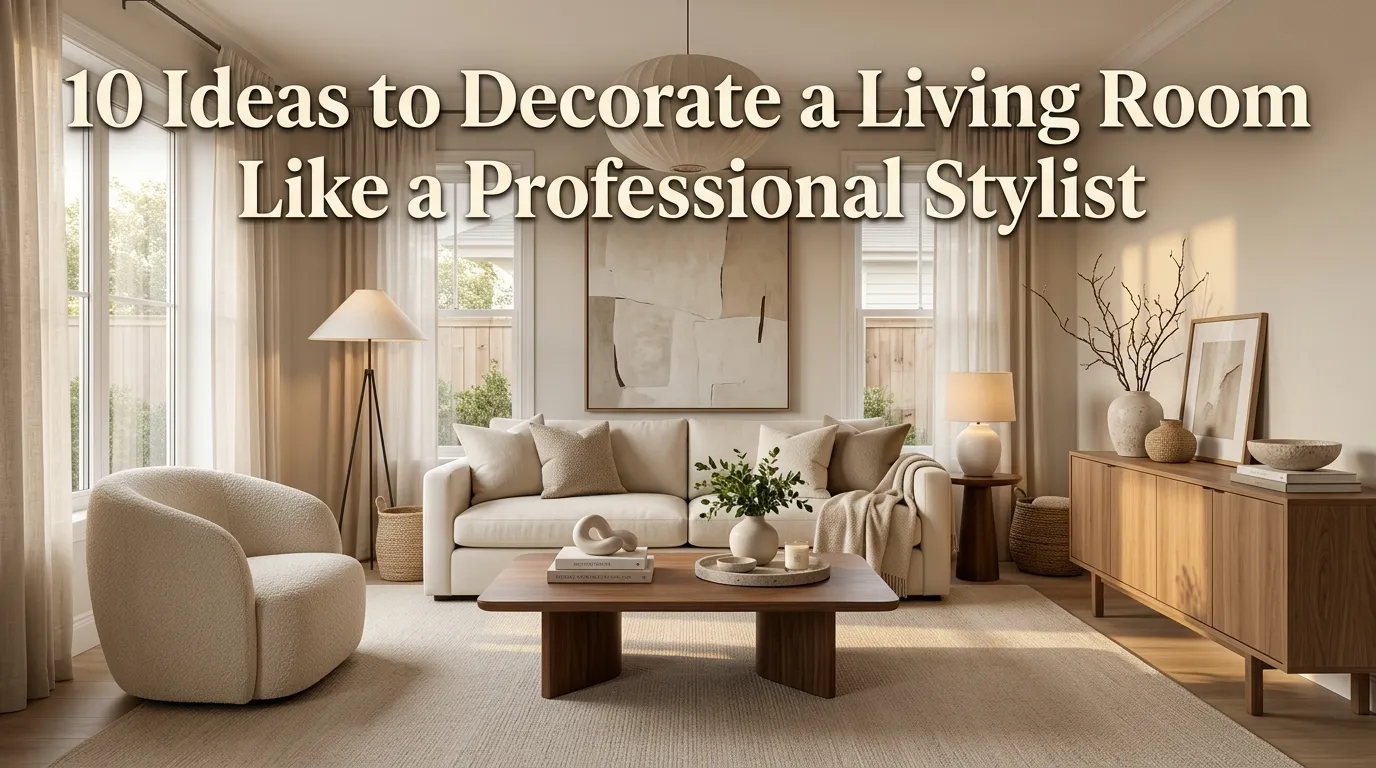
10 Ideas to Decorate a Living Room Like a Professional Stylist
A professionally styled living room rarely feels perfect because every item matches. In fact, the most inviting rooms usually have a thoughtful mix of textures, proportions, colors, materials, and personal details.
The difference is often in the decisions that are easy to overlook.
A professional stylist considers how furniture relates to the room, where the eye naturally travels, how much visual weight each piece carries, and whether the space feels balanced from different angles. They know when to add another layer—and, just as importantly, when to stop.
You can use many of the same principles at home without replacing every piece of furniture.
Sometimes moving the sofa, changing the scale of the rug, lowering artwork, or adding a larger lamp can make a bigger difference than buying an entire new decor collection.
I’ve noticed that one of the most effective ways to improve a living room is to work from large elements toward small ones. Start with the layout and main furniture, establish a cohesive color palette, add lighting and textiles, and only then introduce decorative accessories.
This approach keeps the room from feeling randomly assembled.
Whether your living room is spacious, compact, traditional, modern, transitional, or somewhere in between, these ideas can help you create a polished space that still feels comfortable enough for everyday life.
The goal is not to make your home look like a showroom.
It is to create a room where every major element feels intentional, the proportions work together, and your personality still has room to show.
Table of Contents
1. Plan The Layout
Create a furniture arrangement based on conversation, movement, and proportion.
2. Choose A Palette
Build a restrained color story that makes different pieces feel connected.
3. Scale The Rug
Use the right rug size to visually anchor the entire seating arrangement.
4. Layer The Lighting
Combine multiple light sources to create warmth and dimension.
5. Balance Furniture
Mix furniture sizes and shapes so the room feels visually stable.
6. Mix Textures
Combine fabrics and natural materials for depth and comfort.
7. Style The Walls
Use artwork and wall decor to complete the room without overwhelming it.
8. Add Window Layers
Use curtains and shades to improve softness, height, and privacy.
9. Edit Accessories
Choose fewer decorative pieces and give each one room to stand out.
10. Add Personal Details
Finish the room with meaningful objects that make it feel lived-in.
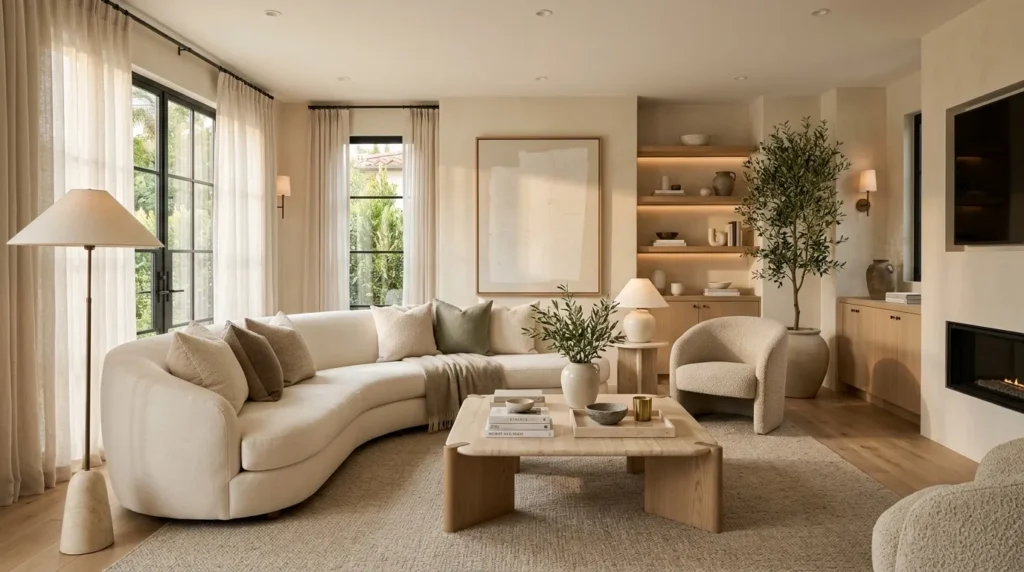
1. Plan The Layout
Quick Benefits
- Improves room flow
- Makes furniture feel intentional
- Creates better conversation areas
- Prevents cramped walkways
- Establishes a professional foundation
Why It Works
Professional styling starts with the floor plan rather than accessories.
A beautiful lamp cannot fix a sofa that blocks a walkway, and a collection of pillows will not make an awkward furniture arrangement feel comfortable.
Before decorating, consider how people naturally enter and move through the room.
The seating should encourage conversation while still allowing comfortable circulation.
In many living rooms, furniture looks better when it is pulled slightly away from the walls rather than pushed against every perimeter.
The exact arrangement depends on the room, but the principle is consistent: create a clear purpose for the central area.
Think about viewing angles too.
The room should look balanced from the entrance, sofa, and main walking paths.
How To Style It
Start with the largest piece, usually the sofa.
Position it according to the room’s architectural features and focal point.
Then add chairs or accent seating to create a conversational arrangement.
A coffee table should be close enough to be useful without interrupting movement.
If you have a fireplace or television, decide whether it should be the primary focal point or simply one element of the room.
Use a simple measuring tape before moving heavy furniture.
Mark possible layouts with painter’s tape on the floor if you’re unsure.
This small step can save considerable effort.
Leave comfortable pathways around major furniture pieces.
A professional-looking room should feel easy to walk through rather than carefully arranged but inconvenient.
2. Choose A Palette
Quick Benefits
- Creates visual harmony
- Makes furniture feel connected
- Simplifies decorating
- Supports seasonal updates
- Makes the room feel polished
Why It Works
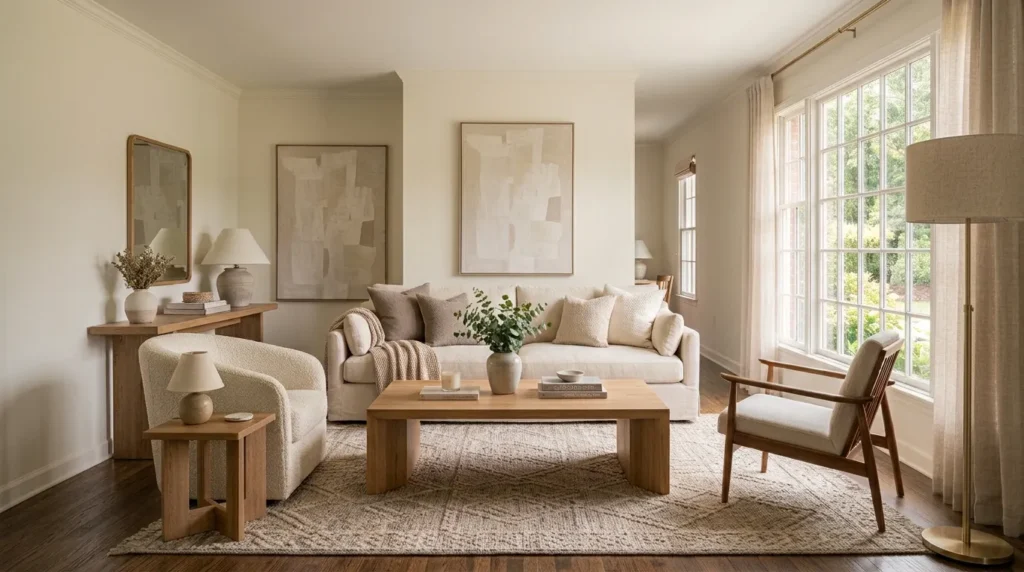
A cohesive color palette is one of the easiest ways to make a living room feel professionally styled.
This does not mean everything should be the same color.
Instead, choose a few dominant shades and repeat them throughout the space.
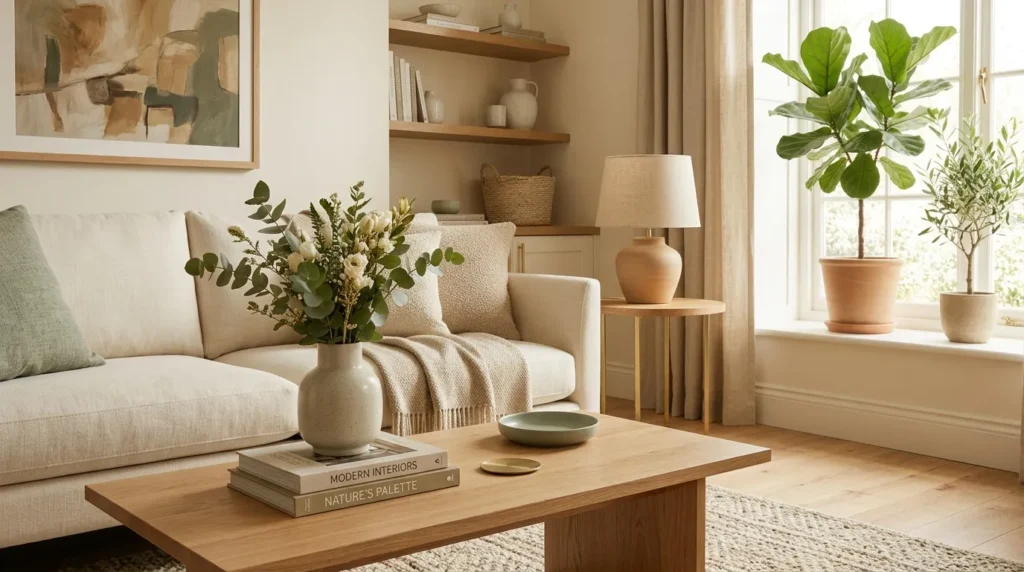
For example, a room might use warm ivory as the foundation, natural wood as the secondary tone, and muted sage as an accent.
The repetition helps the eye move naturally around the room.
Professional stylists often create contrast through tone and texture rather than relying on many competing colors.
A neutral room can still have plenty of personality when it includes warm woods, aged metals, patterned textiles, greenery, and artwork.
How To Style It
Begin with the largest permanent elements.
Consider your flooring, sofa, cabinets, curtains, and existing furniture.
Then select a foundation color that works with them.
Choose one or two secondary colors for furniture and textiles.
Finally, introduce a small accent color through pillows, artwork, flowers, or accessories.
Try repeating each major color at least two or three times.
For example, if you use sage green in a pillow, repeat it in artwork or greenery elsewhere.
Keep undertones consistent.
Warm beige generally works best with warm whites and warm wood, while cooler grays may pair better with cooler whites and metals.
The result should feel collected rather than overly coordinated.
3. Scale The Rug
Quick Benefits
- Anchors the seating area
- Makes furniture feel connected
- Defines the room’s zones
- Adds softness
- Creates visual balance
Why It Works
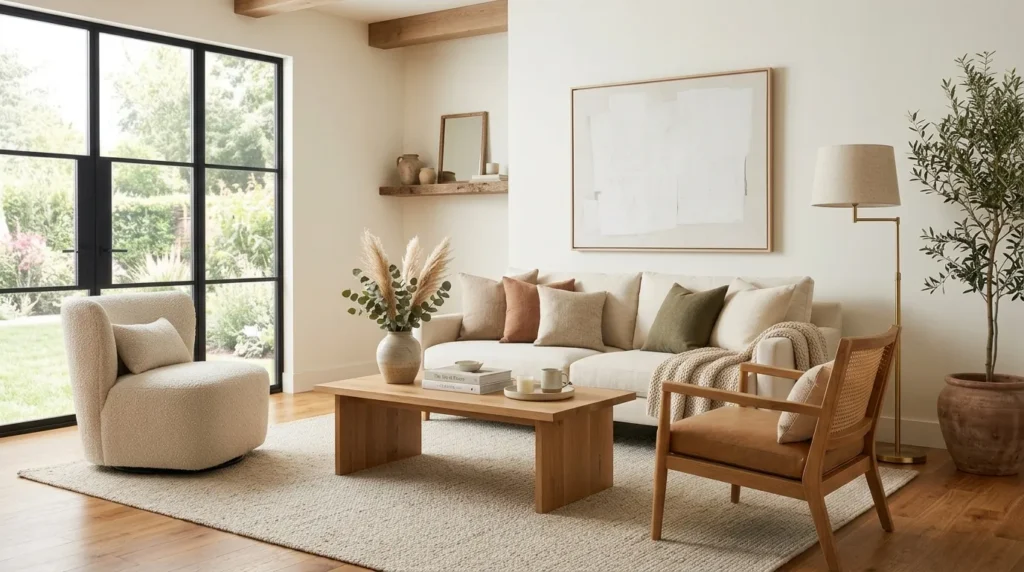
One of the most common living room decorating mistakes is choosing a rug that is too small.
A tiny rug floating beneath the coffee table can make even expensive furniture feel disconnected.
A larger rug visually gathers the seating arrangement and gives the room a stronger foundation.
This is one of those details professional stylists pay close attention to because it affects the entire room at once.
The rug does not need to cover every inch of flooring.
It simply needs to relate appropriately to the main furniture grouping.
How To Style It
Whenever possible, place at least the front legs of the sofa and chairs on the rug.
For a larger living room, an area rug can accommodate the entire seating arrangement.
Choose the size according to the room and furniture rather than buying the smallest option that fits.
If you’re working with an open floor plan, use the rug to visually define the living room.
A neutral textured rug can provide a quiet foundation for colorful furniture.
A patterned rug can become the starting point for the room’s palette.
When choosing the design, consider how it works with your upholstery.
If the sofa is heavily patterned, a simpler rug may be more effective.
4. Layer The Lighting
Quick Benefits
- Creates warmth
- Adds depth
- Improves functionality
- Highlights decor
- Makes evenings more inviting
Why It Works
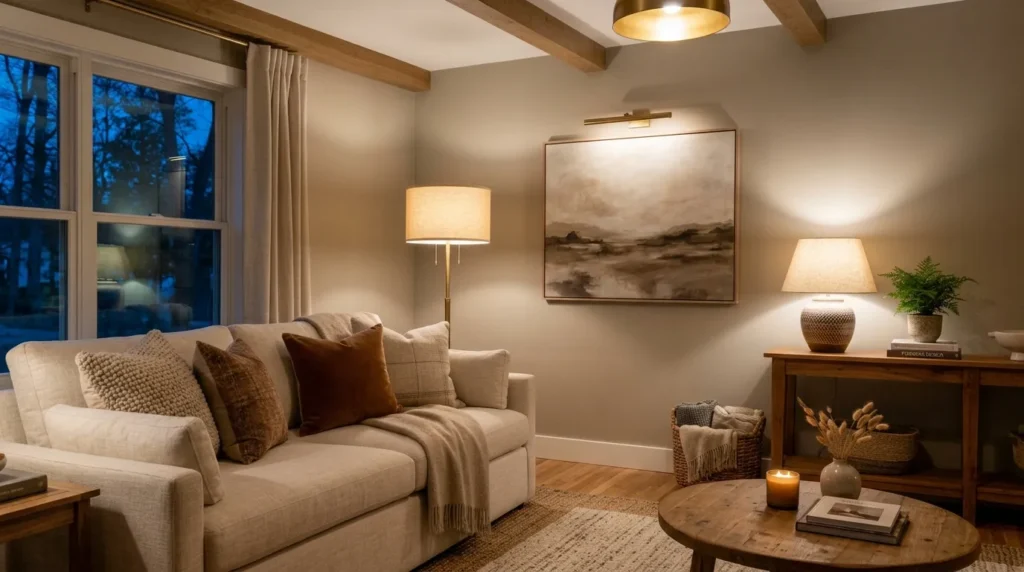
A professionally styled living room rarely relies on one overhead fixture.
Layered lighting creates different levels of illumination and allows the room to change throughout the day.
Think of lighting in three categories: ambient, task, and accent.
Ambient lighting provides general illumination.
Task lighting supports activities such as reading.
Accent lighting highlights artwork, plants, shelves, or architectural features.
When these sources work together, the room feels more dimensional.
I’ve found that simply adding one well-placed floor lamp can transform a living room after sunset.
How To Style It
Start with your existing overhead lighting.
Then add a floor lamp near a reading chair or sofa.
Place table lamps on consoles or side tables.
Use wall sconces where appropriate.
If you have artwork or shelving you want to emphasize, consider suitable accent lighting.
Choose bulbs with a comfortable color temperature appropriate for your desired atmosphere.
Avoid making every light equally bright.
A mixture of stronger and softer illumination creates depth.
Keep lamp shapes proportional to the furniture.
A tiny lamp beside a large sectional may disappear visually, while an oversized lamp can dominate a narrow side table.
5. Balance Furniture
Quick Benefits
- Creates visual stability
- Prevents awkward proportions
- Adds sophistication
- Makes the room comfortable
- Improves overall composition
Why It Works
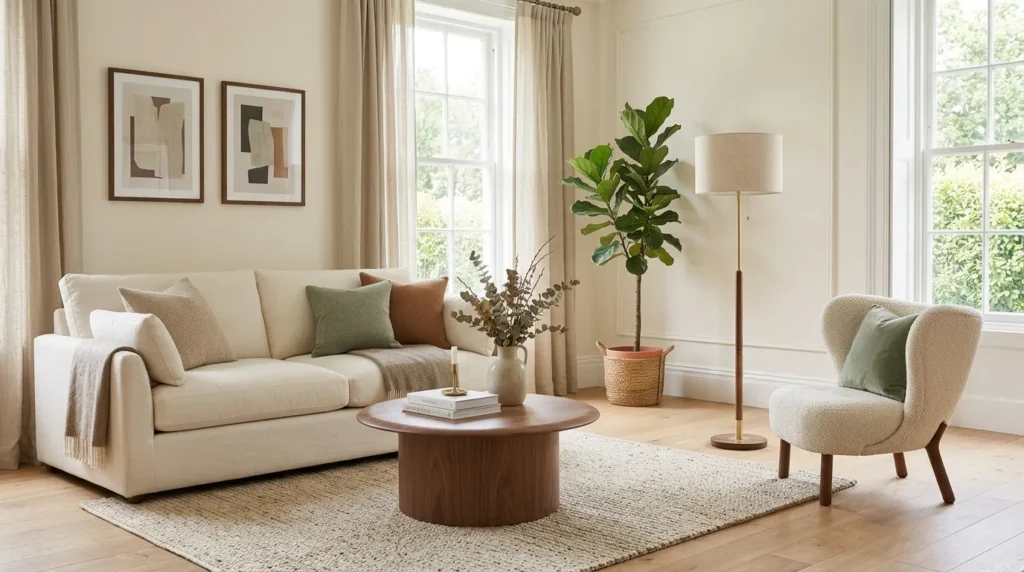
Balance is one of the subtle qualities that makes professionally styled rooms feel effortless.
If every item is large and heavy, the room can feel crowded.
If everything is delicate and small, the space can look unfinished.
The goal is to distribute visual weight.
A large sectional might need a substantial coffee table and appropriately scaled lighting.
A slim sofa may work better with lighter chairs and a smaller table.
Balance does not require symmetry.
An oversized plant on one side can be visually balanced by a floor lamp or tall bookcase on the other.
How To Style It
Look at the room from a distance.
Notice where your eye immediately lands.
If one side feels visually heavy, consider adding height or substance to the opposite side.
Mix rectangular, round, and organic shapes.
A rectangular sofa can be softened with a round coffee table.
A boxy cabinet can be paired with a curved chair.
Vary heights as well.
Use low coffee-table accessories, medium-height lamps, and taller plants or floor lamps.
Avoid putting every object at the same height.
That creates a flat composition.
Instead, create a gentle visual rhythm across the room.
6. Mix Textures
Quick Benefits
- Adds visual depth
- Makes neutrals more interesting
- Creates a cozy atmosphere
- Prevents flat styling
- Makes the room feel layered
Why It Works
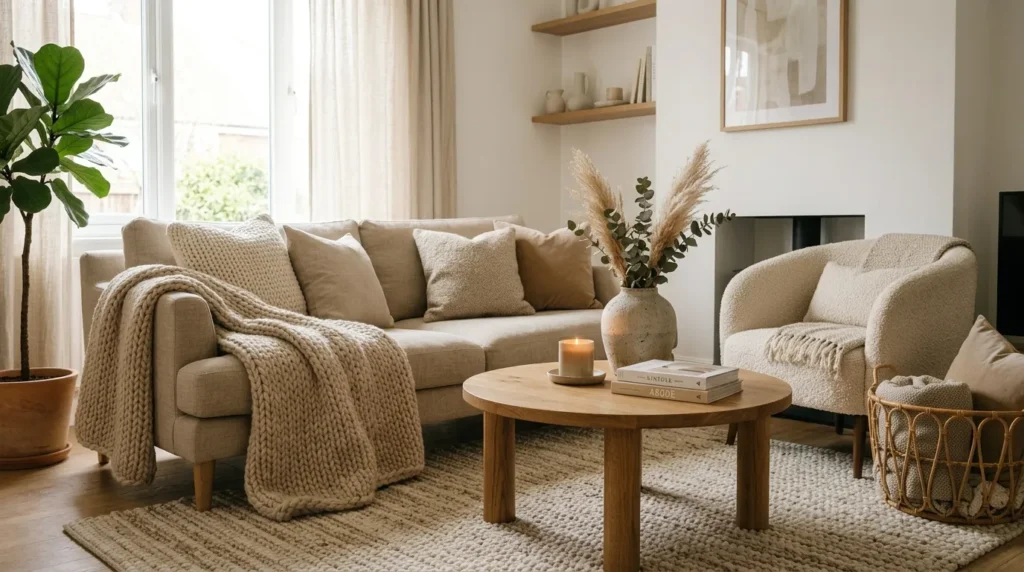
Texture is one of the easiest ways to make a neutral living room feel sophisticated.
When the palette is simple, the materials become more important.
Think about the difference between a room containing only smooth cotton and one combining boucle, linen, wool, wood, ceramic, glass, woven fibers, and metal.
Even if the colors are similar, the second room feels much richer.
Professional styling often relies on this principle.
You can create depth without adding many colors.
How To Style It
Start with upholstered furniture.
Add a woven or textured rug.
Layer linen or cotton pillows with a chunkier knit or boucle option.
Introduce natural wood through a table, stool, or decorative object.
Add ceramics for a handmade quality.
Woven baskets can provide texture while also offering practical storage.
If the room already contains many hard surfaces, introduce softer materials.
If it feels overly soft, add wood, metal, or stone-like accents.
Try not to repeat exactly the same texture everywhere.
Contrast creates interest.
7. Style The Walls
Quick Benefits
- Completes the vertical space
- Adds personality
- Creates focal points
- Improves room scale
- Prevents blank-wall fatigue
Why It Works
Walls are often treated as an afterthought.
But professionally styled rooms use vertical space to create balance.
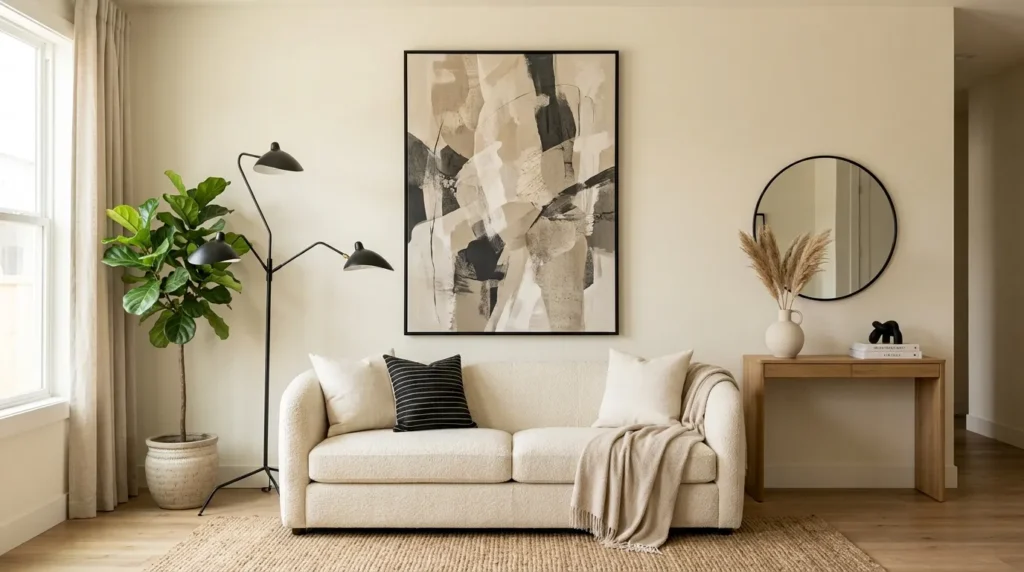
Artwork, mirrors, shelves, architectural molding, and large-scale decor can all influence how the room feels.
The most important consideration is scale.
A tiny piece of artwork floating above a large sofa can look disconnected.
A larger piece or grouped gallery arrangement can better relate to the furniture beneath it.
How To Style It
Start with the largest wall.
If there is a sofa underneath it, consider artwork that occupies a meaningful portion of the wall width without overwhelming the furniture.
For gallery walls, keep some visual relationship between frames, colors, or subject matter.
A large mirror can work well opposite a window because it can reflect natural light and create additional visual depth.
Floating shelves can display books, ceramics, plants, and artwork.
Do not feel obligated to decorate every wall.
One strong focal wall is often more sophisticated than a collection of unrelated objects throughout the room.
8. Add Window Layers
Quick Benefits
- Adds softness
- Makes ceilings feel taller
- Improves privacy
- Controls natural light
- Creates a finished appearance
Why It Works
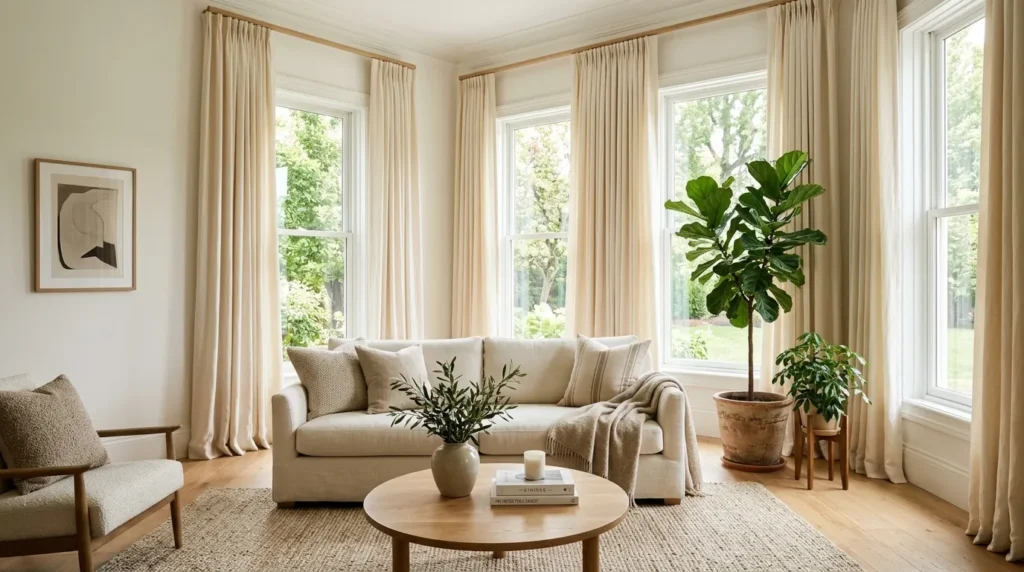
Window treatments can dramatically change the perceived proportions of a living room.
Curtains that are mounted too low or too narrowly can make windows appear smaller.
Installing curtain hardware higher and wider than the window frame, when appropriate for the room, can create a taller and more expansive impression.
Fabric also introduces softness against harder surfaces such as glass, wood, and metal.
How To Style It
Choose curtains based on the amount of privacy and light control you need.
Sheer panels can provide softness while allowing natural light through.
Lined curtains can provide greater privacy and light control.
For a polished appearance, choose panels long enough to reach the floor.
Hang the rod according to the room’s proportions rather than directly against the top of the window frame.
Keep the color related to your overall palette.
Warm ivory, beige, soft gray, or muted earth tones are versatile choices.
Avoid overly complicated patterns if the room already contains several visual elements.
9. Edit Accessories
Quick Benefits
- Reduces visual clutter
- Highlights favorite objects
- Creates breathing room
- Makes styling feel intentional
- Simplifies cleaning
Why It Works
One of the biggest differences between decorated and professionally styled spaces is editing.
It is tempting to display every attractive object you own.
But when every surface is full, individual pieces lose their impact.
Professional styling usually includes intentional empty space.
That breathing room allows the eye to rest and makes selected objects more noticeable.
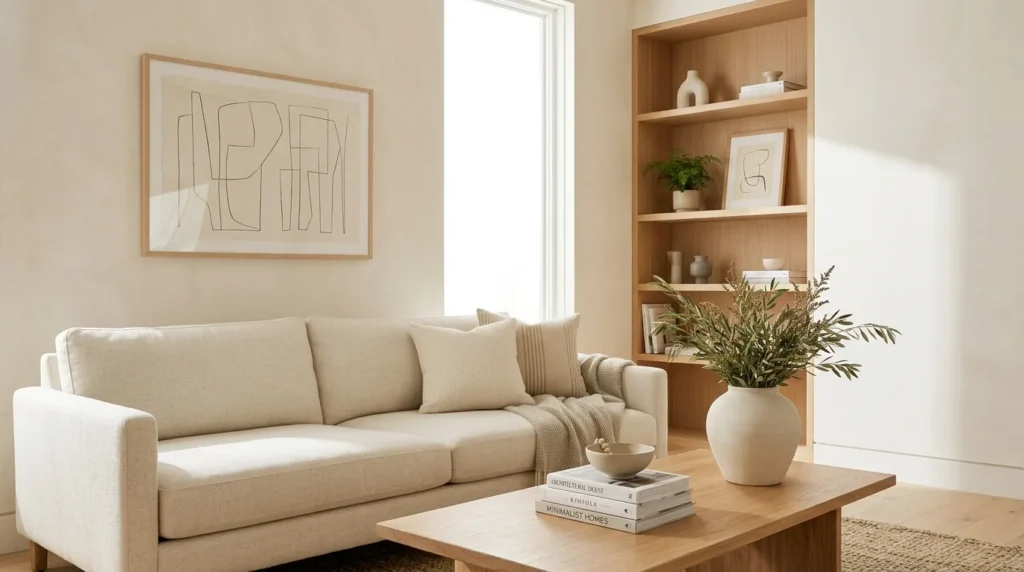
A beautiful ceramic vase can have more impact sitting alone than surrounded by ten smaller accessories.
How To Style It
Start by removing about one-third of the decorative objects from your surfaces.
Then group the remaining pieces according to height, material, and purpose.
Use trays to organize small objects.
Stack books horizontally to create different levels.
Place a vase or sculptural piece on top.
On shelves, leave some open space between groups.
Avoid placing similar objects in perfectly equal rows unless you specifically want a symmetrical look.
Rotate seasonal accessories rather than continually adding new pieces.
This keeps the room fresh without creating clutter.
10. Add Personal Details
Quick Benefits
- Makes the room feel authentic
- Adds emotional character
- Prevents showroom styling
- Creates conversation pieces
- Reflects your lifestyle
Why It Works
A professionally styled room should still feel like someone lives there.
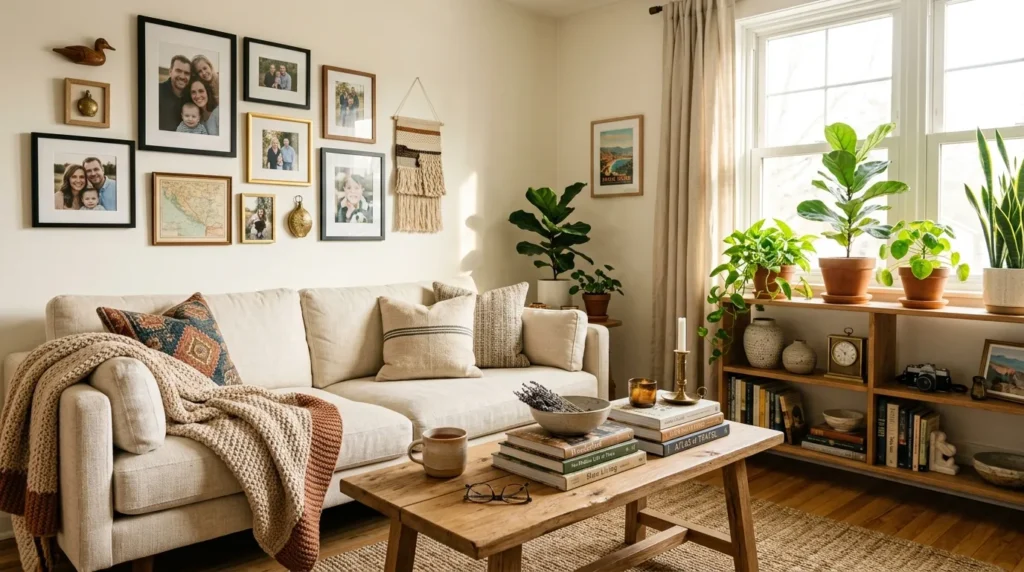
The most memorable interiors usually include personal elements: travel finds, family photographs, books, handmade pieces, artwork, vintage objects, or collections gathered over time.
These details add personality that cannot be achieved by purchasing an entire matching decor set.
The trick is integration.
Personal objects should complement the overall palette and composition without disappearing into it.
How To Style It
Choose a handful of meaningful pieces rather than displaying everything at once.
Place favorite books on the coffee table.
Use a framed photograph on a console.
Display a handmade ceramic piece on an open shelf.
Bring in a vintage object alongside newer furniture for contrast.
If you collect something, group several related pieces rather than scattering them randomly.
Allow personal items to have breathing room.
The result should feel curated but not overly staged.
That balance is what makes a professionally inspired living room still feel warm and genuinely yours.
Professional Living Room Styling Formula
If you’re unsure where to begin, use a simple styling sequence.
1. Start with the layout.
Make sure furniture placement supports conversation and movement.
2. Establish the palette.
Choose a foundation color, secondary tones, and one or two accents.
3. Add the rug.
Use it to anchor the main seating arrangement.
4. Layer lighting.
Combine overhead, floor, table, and accent lighting where appropriate.
5. Add texture.
Mix upholstery, wood, woven materials, ceramics, and textiles.
6. Style the walls.
Choose artwork or mirrors that relate to the scale of the furniture.
7. Add window treatments.
Use fabric to soften the room and frame the windows.
8. Edit accessories.
Remove anything that feels repetitive or unnecessary.
9. Add personal pieces.
Bring in objects that tell your story.
10. Step back.
Look at the room from the doorway and main seating area.
If something feels visually heavy, remove or reposition it.
Common Living Room Styling Mistakes
Even a beautiful room can feel slightly off when a few common mistakes are present.
Using A Tiny Rug
A small rug can disconnect the furniture.
Pushing Everything Against Walls
This can create a large empty center while making the seating feel disconnected.
Using Only One Light Source
Overhead lighting alone can make a room feel flat.
Matching Everything
A complete furniture set can lack visual personality.
Overdecorating
Too many accessories can hide the architecture and furniture.
Ignoring Scale
Furniture and decor should relate to one another.
Hanging Artwork Too High
Art should generally feel connected to the furniture below it.
Choosing Style Over Comfort
A living room is meant to be lived in.
Beautiful furniture should still be practical.
FAQ
How do I make my living room look professionally decorated?
Start with furniture placement, scale, and a cohesive color palette. Then anchor the seating with an appropriately sized rug, layer several lighting sources, introduce different textures, and finish with carefully edited accessories. Personal objects should be included so the room feels authentic rather than like a showroom.
What is the most important part of styling a living room?
Layout is one of the most important elements because it affects both appearance and functionality. A beautiful room can still feel uncomfortable when furniture blocks pathways or prevents conversation. Begin by creating a practical furniture arrangement, then build the decorative layers around it.
How many colors should a living room have?
There is no strict rule, but a restrained palette of a few related colors often creates a polished appearance. You might use one dominant neutral, one or two supporting tones, and a small accent color. Repeating colors throughout the room helps different furniture and accessories feel connected.
How can I make a neutral living room more interesting?
Use texture rather than adding lots of colors. Combine linen, boucle, wool, wood, rattan, ceramic, metal, and glass. Vary the shapes and heights of furniture and accessories. Plants and artwork can also introduce subtle color without disrupting a neutral palette.
Should all living room furniture match?
No. Coordinated furniture usually looks more sophisticated than a completely matching set. Mix materials, silhouettes, and finishes while keeping a connection through color or scale. For example, a neutral sofa can work beautifully with a wooden coffee table, woven accent chair, and metal floor lamp.
How do professionals style a coffee table?
Start with a tray to organize smaller objects. Add a few coffee-table books, then introduce one organic or sculptural element such as a plant, vase, or ceramic bowl. Vary the heights of the objects while leaving enough empty space for practical use.
How can I make my living room look expensive on a budget?
Prioritize scale, layout, and finishing details instead of buying many accessories. A properly sized rug, attractive lighting, well-hung curtains, and a cohesive color palette can make a significant difference. Decluttering and rearranging existing furniture can also create a more polished appearance without spending much.
Conclusion
Learning to style a living room like a professional is less about buying expensive furniture and more about understanding how the pieces work together.
Start with the layout.
Make sure the room is easy to move through and comfortable for conversation.
Then establish a color story that connects the major elements.
Use a properly scaled rug to anchor the seating, layer lighting to create warmth, and mix textures to add depth.
From there, look upward.
Artwork, mirrors, curtains, shelves, and other vertical elements can make the room feel complete.
Finally, edit.
Remove accessories that do not contribute anything to the overall composition.
Then bring back the objects that genuinely matter to you.
One of the most useful styling lessons is that a room does not need to be full to feel finished.
Sometimes removing one chair, clearing a crowded shelf, or replacing several tiny accessories with one larger piece creates the biggest improvement.
And remember that professional-looking does not have to mean formal.
Your living room should still support movie nights, family conversations, morning coffee, reading, entertaining, and all the ordinary moments that make a house feel like home.
Choose comfort first.
Then add beauty through proportion, texture, lighting, and thoughtful details.
Start with one area today—perhaps the seating arrangement or coffee table—and build from there.
Small styling decisions can gradually turn an ordinary living room into a space that feels intentional, welcoming, and completely your own.
Related Articles
- 10 Cozy Living Room Ideas with Comfortable Furniture
- 11 Modern Living Room Ideas for a Stylish Home
- 10 Neutral Living Room Ideas That Feel Warm and Inviting
- 10 Living Room Lighting Ideas for a Cozy Atmosphere
- 11 Small Living Room Ideas with Smart Furniture